Dayton Audio
Dayton Audio - 5½" Passive Radiator Carbon Fibre - E150HE-PR
Dayton Audio - 5½" Passive Radiator Carbon Fibre - E150HE-PR
In stock
Stock status is updated regularly from my distributor. If the full quantity ordered isn’t available, I’ll get in touch.
Couldn't load pickup availability
Description
Dayton Audio’s ground breaking Epique E150HE-PR 5-1/2” with a carbon fibre cone is the perfect companion for the Epique Series MMAG Subwoofers while retaining the same family look. It was engineered for a low FS in order to replace the excessive port lengths required for low-tuned enclosures. The E150HE-PR passive radiator gives you the opportunity to create systems that provide extraordinary accuracy and fidelity, without the extraordinary size.
Combining world class performance with a reasonable cost, the Epique E150HE-PR 5-1/2" carbon fibre cone passive radiator from Dayton Audio is the perfect companion for the Epique Series MMAG Subwoofers. Featuring a carbon fibre cone, custom tooled suspension, and cast aluminium frame, the low FS of the E150HE-PR enables speaker designers to use smaller and lower tuned boxes without the excessive port lengths.
When designing the E150HE-PR, Dayton Audio paid extra attention to optimising the suspension to guarantee unrestricted excursion without limiting performance. The large roll rubber surround was custom tooled for high excursion and a custom weighted spider was created to lower the FS for maximum performance and easier tuning.
The rigid carbon fibre cone gives the E150HE-PR retains a familiar look while offering a number of performance advantages. The woven cone has excellent damping properties which keep the active driver well controlled. Optimised cone and dustcap profiles make sure that there is no deformation when exposed to high stress so the smooth response and low distortion remain consistent even when pushed to high excursion
In order to support its extreme excursion, the E150HE-PR uses a rugged cast aluminium frame. The minimalistic design of the frame both eliminates unwanted flex and provides ample room for the rear of the cone. 19mm of Xmech, and plenty of room behind the spider makes sure that you can push the limits of excursion without bottoming out.
- (1) Passive Radiator
- (3) 30 gram disk weights
- (1) Nylon locking nut (for final assembly)
Tip: As a general rule, the passive radiator(s) should have at least double the displacement of air (Vd) as the active woofer(s)/subwoofer(s) in the system. To calculate Vd=Xmax ∗ Sd
Features
- Passive radiators for the exceptional Epique Series enables you to use smaller boxes by replacing ports with excessive lengths
- Carbon fibre cone is strong enough to handle the pressure of high output drivers
- Incredibly linear 19mm xmech enhances output at low tunings
- Incredible versatility, perfect compliment for any compact subwoofer
- Cosmetically identical to the Epique MMAG subwoofers
Specifications
Specifications
General
| Driver type | Passive Radiator |
|---|---|
| Nominal size | 5.5" |
| Series | Epique |
Thiele/Small parameters
| Resonant frequency (Fs) | 30 Hz |
|---|---|
| Mechanical Q (Qms) | 3.33 |
| Equivalent volume (Vas) | 4.81 L |
| Compliance (Cms) | 0.38 mm/N |
| Moving mass (Mms) | 76.5 g |
| Mechanical resistance (Rms) | 4.29 kg/s |
| Effective piston area (Sd) | 95 cm² |
| Linear excursion (Xmax, one-way) | 19 mm |
| Mechanical excursion (Xmech) | 19 mm |
| Displacement volume (Vd) | 180.5 cm³ |
Mounting
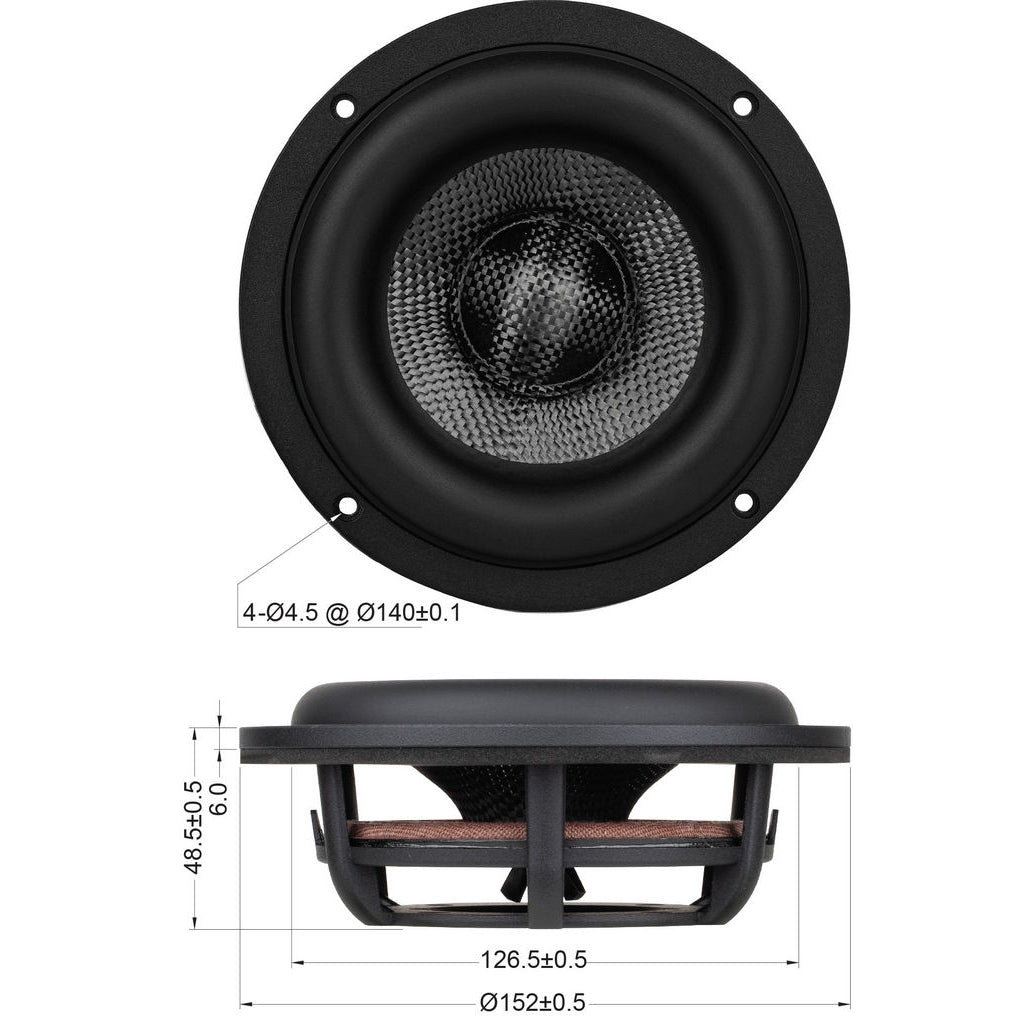
| Overall diameter | 152 mm |
|---|---|
| Cutout diameter | 126.5 mm |
| Mounting depth | 43 mm |
| Flange thickness | 5.5 mm |
| Bolt circle diameter | 140 mm |
| Mounting holes | 4 |
| Mounting hole diameter | 4.5 mm |
| Weight | 1.361 kg |
Materials
| Cone | Carbon Fibre |
|---|---|
| Surround | Rubber |
| Basket | Cast Aluminium |
- Xmax is quoted one-way (peak), not peak-to-peak.
Downloads
- Epique E150HE-PR Specification Sheet
- Epique E150HE-PR Mechanical Drawing
- E150HE-PR Cutout & Recess Template (NB Audio) Every figure is straight off Dayton Audio's own spec sheet. Check it against your driver before you cut.
Where do these figures come from? See the source of each one